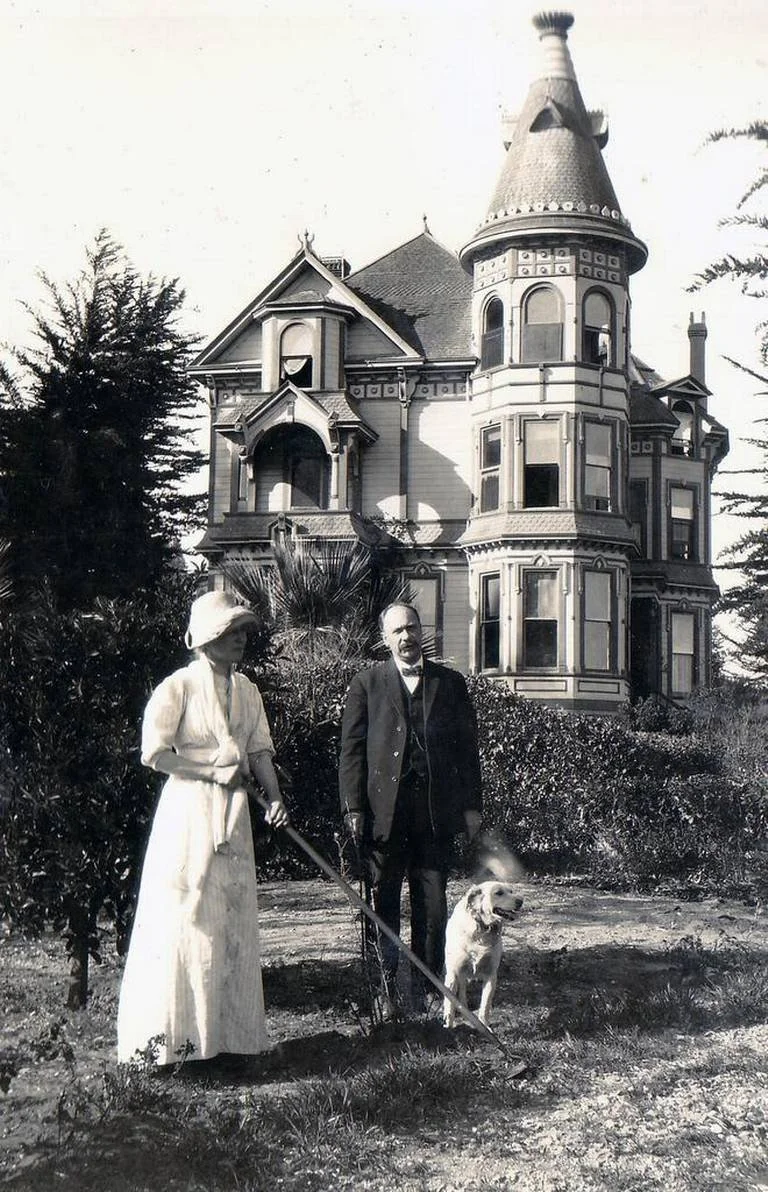
Dr. William H. Dower outside the former Coffee T. Rice Mansion, Oceano California.
Along the old coast road in Oceano, where the farmland stretches toward the sea and the wind carries sand into the smallest crevices, stands a Victorian house that has outlived nearly every ambition for which it was built.
Its name belongs to Coffee T. Rice.
In the 1880s, Rice came to this portion of the California coast with the expectation that the Southern Pacific Railroad would soon pass through it. He purchased hundreds of acres, imagining the commerce and settlement that might follow the arrival of the iron road.
And upon that land, he built a house.
Completed in 1886, the residence contained twenty rooms, with marble fixtures, elaborate fireplaces, and materials brought from far beyond the little coastal settlement. Its grounds were laid out with trees, a sundial, a circular drive, and even a racetrack. It was a house constructed not merely for domestic life, but for the prosperous future its owner believed was approaching.
The railroad was slow to come.
While Rice waited, the fortunes of his family changed. His young son died, his financial circumstances deteriorated, and the great house passed out of his hands. By the time the railroad reached Oceano in 1895, the man who had placed so much faith in its arrival had already departed.
Yet the house remained.
At the beginning of the twentieth century, another movement came to this stretch of coastline. The Temple of the People, a spiritual community established at nearby Halcyon, acquired the Rice property and transformed the former family residence into a sanitarium.
The building entered a second life.
The Halcyon movement drew upon theosophical philosophy, spiritual study, and ideas concerning the relationship between the body, the mind, and the natural world. The sanitarium belonged to an age when the restorative qualities of sunlight, fresh air, and peaceful surroundings were regarded with particular interest.
For a time, the rooms that had once belonged to a wealthy household were occupied by those seeking rest and treatment.
Beyond the windows lay the agricultural fields, the old roads, and the immense dunes that would later become home to another remarkable community of seekers.
During the 1930s and 1940s, the Dunites lived among those shifting sands. Writers, artists, hermits, and independent thinkers established modest dwellings and published their ideas in The Dune Forum. They believed the dunes possessed a creative and spiritual significance that could not easily be found within the conventions of ordinary society.
It is this succession of lives that holds my attention.
A financier waiting for the railroad. A spiritual community tending to the sick. Writers living beyond the edges of town, committing their thoughts to paper while the sand gathered against their doors.
Different people, different purposes, and yet each drawn to the same narrow portion of the California coast.
The house still stands, though the world for which it was built has changed almost beyond recognition. Its former grounds have been divided and altered. The sanitarium has closed. The little dwellings of the Dunites have largely disappeared, and the wind continues its patient work upon the landscape.
But the records remain.
In old newspapers, photographs, books, and the recollections of those who came before us, there survives another Oceano. One of unfinished ambitions, spiritual experiments, seaside settlements, and lives conducted quietly beyond the attention of the wider world.
It is from this history that Smokey Lonesomes has taken its beginning.
And it is here that I intend to keep a record of what I find.
Not only the grand histories, but the smaller ones. The forgotten names, the vanished buildings, the peculiar ambitions of ordinary people, and the objects they left behind.
There is much yet to be learned about this house and the land surrounding it.
For now, I begin with the man who built a house for a future he would never see.
S.L.