The House That Waited for the Railroad
There has always been a house…
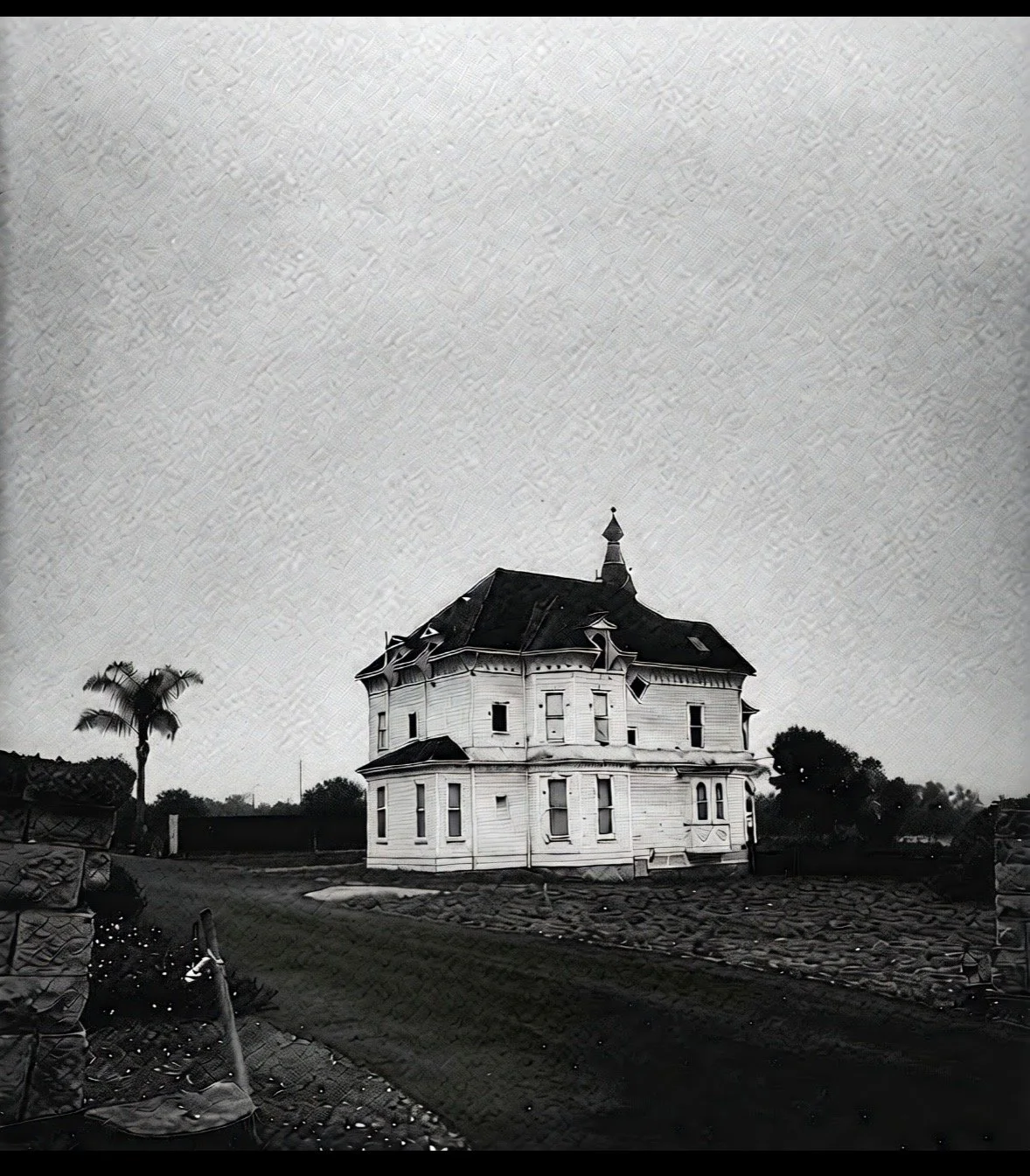
An old Victorian house standing apart from everything around it, with a dark roof, tall windows, and a little turret reaching towards the stars.
The Coffee T. Rice Mansion.
I have been haunted by this house since I was a child.
Not haunted in the frightening sense, but in the way certain places seem to take up residence inside of you. I would dream about it. I would think about it when I wasn’t trying to. There was something strangely familiar about it, though I couldn’t have explained why.
I only knew that I wanted to go inside.
I imagined what the rooms might look like. What the floors sounded like beneath someone’s footsteps. What might have been left behind in the closets and cupboards. Old linens, books, clothing, handwritten notes, little objects that had once belonged to someone whose name had been forgotten.
And somehow, I always imagined myself there.
As the years passed, the house never quite left me.
I began to learn a little of her history.
There was a time when this small corner of California was full of grand expectations. Men came with schemes for railroads, new settlements, and fortunes yet to be made. The future was spoken of with such certainty that one might have believed it had already arrived.
But the land had other ideas.
The railroad would not arrive on time, as some had imagined. Dreams of prosperity faltered. People came and went, leaving behind their houses, their gardens, and the peculiar evidence of lives once lived in earnest.
And there stood the old mansion, belonging to a story much larger than I had understood as a child.
The house that waited for the railroad.
I have often wondered whether that is part of what drew me to her. The strange tenderness of a place built with such hope for the future, only to become a keeper of the past.
And she was hardly alone.
This coast has witnessed its share of peculiar ambitions. Seaside amusements, buildings raised against the shifting dunes, and great groves of eucalyptus planted by those who imagined a different future for this land. Some things flourished. Others were abandoned, dismantled, or slowly reclaimed by the elements.
Long before these endeavors, the Indigenous peoples of this coast had histories, relationships, and ways of knowing the land that remain part of its living heritage.
I think often of how many stories a single place can hold.
How the wind moves the sand over what was once familiar. How a garden grows wild after its keeper has gone. How the smallest evidence of an ordinary life can outlast the grandest of plans.
Perhaps that is why I have always been drawn to old things.
Not because I believe the past was better, but because I cannot bear the thought of it being forgotten.
Somewhere along the way, I began to imagine a shop inside that old house.
Not a polished, modern shop, but something quieter. A place filled with old things and handmade things. Where candles burned on wooden tables, books rested among the small remnants of other people’s lives, and artists gathered to share their work and stories.
Rosemary and smoke filling the air.
That imagined shop, a home for wayward souls who keep strange hours, eventually became Smokey Lonesomes.
I suppose I began by collecting the feeling of that house.
Things with a little age in them.
Things made by an artist’s hands.
Things softened by use.
Things that don’t need to be perfect to be beautiful.
I have always believed there is something special about an object that has already lived a life. A cotton quilt washed a hundred times. A wooden tool darkened where hands have held it. An old book with someone’s handwriting or pressed flowers tucked inside.
The marks of use don’t diminish things.
They are the story.
And perhaps that is what has kept drawing me back to this house.
It represents something I have been trying to build long before I had a name for it: a place where the old and ordinary might be cherished again. Where the domestic and the mysterious can sit beside one another near the fire, and the natural world is woven quietly into daily life.
Smokey Lonesomes is the shop I have carried with me for years.
For now, it lives here, in this simple little corner of the world I’ve created online.
A gathering of old books, household antiquities, primitive handcrafts, ritual goods, and botanical preparations inspired by the flora of our coastal home.
Things made slowly. Things softened by use. Things that have already lived a life, and might yet have another.
And alongside these goods, a place for stories.
I have begun keeping a written record of the landscape from which Smokey Lonesomes was born. The old sanitarium, the settlements along the dunes, the writers and wanderers who made their homes upon the sand, and the forgotten ambitions of this little stretch of California coast.
Through old newspapers, photographs, books, and the traces left upon the land, I hope to preserve something of the lives that came before us.
There is still so much I do not know. So many histories waiting quietly in the margins.
The House Journal is where I intend to gather them.
I still picture the shop inside that old house. The artists living beside me, filling its rooms with their presence. A warm fire, guests wrapped in wool blankets, and meals shared around a table.
Until then, I’ll keep gathering the things that feel as though they belong there. Things with stories. Things waiting for another life.
And I will keep writing about the place that made me love them.
Perhaps Smokey Lonesomes was never really something I tried to create.
Perhaps it is simply the place that has been waiting for me to find my way home…
-S.L.